ENS Headlines
Economic Justice Committee invests in Bank of Palestine
[Episcopal Church Office of Public Affairs] As approved by the Episcopal Church Economic Justice Loan Committee (EJLC) of the Executive Council and as part of its economic justice portfolio, The Episcopal Church recently purchased a three-year certificate of deposit for $500,000 in the Bank of Palestine.
This action, approved in late January by EJLC, is in response to several resolutions affirmed by the General Convention, most recently Resolution B019 approved by General Convention in July 2012.
Presiding Bishop Katharine Jefferts Schori said, “I am delighted that The Episcopal Church has now made a positive investment in the Palestinian economy, an action which we have encouraged for some time. This is tangible evidence of our commitment to a healthy economy in the Palestinian territories as a necessary instrument to building a lasting peace.”
The investment is part of the assets which were set aside by Executive Council in November 1989 for socially-responsible fixed-income investments. At year-end 2012, the investments consisted of $3.6 million in deposits at credit unions and similar intermediaries; and $2.1 million in loans to community development intermediaries made through the Economic Justice Community Development Loan Fund.
“Interest earned from these investments is typically below market rates, though an effort is made to achieve rates above the inflation rate in order to safeguard the principal available for future loans,” explained N. Kurt Barnes, Episcopal Church treasurer. “The interest earned in this program flows to the DFMS operating budget.”
In preparation for the purchase, the Episcopal Church Finance Office worked with several organizations, including the Holy Land Christian Ecumenical Foundation, to identify business opportunities in Palestine. The EJLC concluded that an investment in the Bank of Palestine made the most sense. Barnes continued, “The primary mid-size to large businesses in Palestine are banking services, IT and Call Centers, hospitality and tourism. The banking sector offers liquidity; and as the leading bank in Palestine, the Bank of Palestine is a logical candidate, which in turn will get the money out to community development activities within Palestine.”
Barnes, who met with senior management of the Bank of Palestine, noted that the bank:
• Has well-developed corporate-governance and risk-management structures based on best practices generally seen in North America;
• Makes nearly 20% of its $720 million loan portfolio available to micro and small businesses (SMEs) employing over 10,000 Palestinians;
• Has a green loans program, which encourages water wells, wastewater management and alternative energy sources in order to reduce reliance on often unstable Israeli-sourced energy; and
• Contributes 5% of its net profit each year to Corporate Social Responsibility initiatives.
Bishop Stacy Sauls, Episcopal Church Chief Operating Officer, commented, “One of the ways we seek to serve at the churchwide level is to make it easy for the Church at the local level, dioceses and congregations, to act on our common convictions. Several dioceses have already approached us about helping them take similar action. Co-investing with us pools resources for good and allows smaller units of the Church to take advantage of the work done on their behalf and access services and opportunities that might not otherwise be available to them. That’s what the churchwide level exists to do.”
Lindsey Parker, of the Diocese of Massachusetts and chair of the EJLC, noted, “We are pleased to receive the Bank’s assurance that the deposit will be directed to SMEs; the Bank’s Green Loans Program; or the soon-to-be introduced SME loans for women.”
Video: Designer Juliet Hemingray on the archbishop’s vestments
[There is a video that cannot be displayed in this feed. Visit the blog entry to see the video.]
[Episcopal News Service] The vestments worn by Archbishop of Canterbury Welby during the enthronement service were originally designed and made 21 years ago by Juliet Hemingray for the late Bishop of Peterborough Ian Cundy. They were bought as a gift for Cundy from the students and staff at Cranmer Hall, Durham, where Welby was a student.
Order of service for archbishop of Canterbury’s inauguration released
[Episcopal News Service] The order of service for the March 21 inauguration of Archbishop Justin Welby in Canterbury Cathedral is available as a PDF document here.
The service, during which Welby will be formally enthroned as the 105th archbishop of Canterbury, begins at 3 p.m. local time (11 a.m. EST).
The British Broadcasting Corp. plans to stream the service live here between 2:30 p.m. – 4:30 p.m. local time, with highlights of the service featured on BBC World News 24 between 2:55 p.m. – 4:00 p.m.
Lambeth Palace, the Church of England and ACNS will be tweeting throughout the day using #ABC105, and there will be news articles, photos and updates on www.anglicancommunion.org/acns, www.churchofengland.org and www.archbishopofcanterbury.org as well as their Facebook pages.
Episcopal News Service will post written and video coverage of the service.
Anglicans worldwide invited to pray for their spiritual leader
[Anglican Communion News Service] As Archbishop Justin Welby prepares for his inauguration in Canterbury today, the 85 million members of the Anglican Communion are being invited to pray for him and his ministry.
The Anglican Communion Office has today issued a prayer that Anglicans and Episcopalians can say before Welby becomes the 105th occupant of the Chair of St. Augustine.
Welby’s Confirmation of Election took place in St. Paul’s Cathedral in London on Feb. 4 That was a relatively low-key legal ceremony, whereas today’s service will include African dancers, Punjabi music, a Burundian blessing, and strong representation from the other main Christian Churches around the world. This makes plain the importance of the global Anglican Communion to the archbishop of Canterbury, and the drive towards the deeper unity of all Christians.
A prayer for the Most Rev. & Rt. Hon. Justin Welby as he is enthroned as the 105th archbishop of Canterbury
Lord Jesus Christ, Son of the living God,
through whom all things live and move and have their being;
pour out your Holy Spirit and the boundless gifts of grace
upon your servant Justin,
that being daily renewed,
he may faithfully serve you
in the ministries which you have entrusted to him;
giving glory to you,
who with the Father and the Spirit,
are One God, now and for ever, to the ages of ages. Amen.
Nominees for bishop slate announced in Western Michigan
[Diocese of Western Michigan -- Press Release] The Search Team has nominated three priests to stand for election as the 9th Bishop of Western Michigan. The nominees for bishop are:
- The Rev. Jennifer Adams, Rector, Grace Episcopal Church, Holland, Michigan (Diocese of Western Michigan)
- The Rev. Whayne Hougland, Jr., Rector, St. Luke’s Episcopal Church, Salisbury, North Carolina (Diocese of North Carolina)
- The Rev. Canon Angela Shepherd, Canon for Mission, Diocese of Maryland
A letter from each nominee, as well as a summary of education and experience, is included in the slate announcement booklet. The booklet also includes a report of the Search Team describing the search process.
To download the booklet as a PDF file, please click here: Nominee Profiles & Petition Process.
The booklet is also available for viewing in magazine format here.
Further information will be provided about all nominees, including any nominees by petition, in a ballot announcement scheduled for publication on April 22, 2013.
The Transition Team will host a series of informational events with nominees from May 3rd-5th at three locations in the diocese; these events will include nominees by petition.
The electing convention will be held on May 18, 2013, at Grace Episcopal Church, Grand Rapids.
Following the election of the Ninth Bishop, the required consents will be sought from other dioceses of the Episcopal Church.
Petition ProcessPetition Process information is included in the slate announcement booklet on pp. 14-17.
The Rev. Canon Robert Schiesler, President of the Standing Committee, announces that the Committee is accepting Nominations by Petition from March 20 through April 15, 2013.
Due to the time required to complete the required background checks, the Standing Committee asks that any petition candidates indicate their intention by immediately emailing the Committee President, The Rev. Canon Robert Schiesler, with name, address & contact phone. [Canon Schiesler's email address is published on p. 14 of the slate announcement booklet.]
The form for nominations by petition can be downloaded separately here: Petition Form.
Anglican Communion prepares for Archbishop Welby’s inauguration
[Anglican Communion News Service] Members of the worldwide Anglican Communion are gearing up for the March 21 inauguration of Archbishop of Canterbury Justin Welby at Canterbury Cathedral.
As staff at the cathedral get ready for this key moment in Anglican history, lay and ordained people from right around the world are also preparing for the big day.
Over the past week the communion’s primates — the most senior bishops from across the Anglican Communion — have travelled to England for the inauguration. Many have made the most of their visit by attending meetings while in the U.K. Primate of West Africa, the Most Rev. Tilewa S. Johnson, visited the mission agency Us (formerly USPG). He also recorded a piece on the Church of England’s new primate for BBC’s Radio 4 Sunday programme. Among other visits the Primate of the Episcopal Church in Jerusalem and the Middle East headed to a housing project in Lancashire.
All the Anglican Communion Standing Committee members will attend the inauguration. Chairman of the Standing Committee and the Anglican Consultative Council, and Bishop of Southern Malawi, the Rt. Rev. James Tengatenga told ACNS, that the inauguration “is an important moment for our Anglican Communion because it marks the beginning of Archbishop Welby’s leadership of our global family.
The Igreja Episcopal Anglicana do Brasil (The Episcopal Anglican Church in Brazil) has said that its members, along with ecumenical partners, are praying for the Archbishop of Canterbury’s big day. A statement issued by the National Council of Christian Churches of Brazil said: “We are praying for [his] ministry to be fruitful and to continue the traditional commitment of the Anglican Church in deepening the dialogue and unity amongst Christians and for the common service in favour of justice, peace, and the integrity of creation.”
Representatives of the Anglican Communion at the Pope’s inaugural mass on March were travelling back from Rome to Canterbury March 20. These include the bishops of the Church of England’s Diocese in Europe, the Rt. Rev. Dr. Geoffrey Rowell and the Rt. Rev. David Hamid; and Secretary General of the Anglican Communion, the Rev. Canon Kenneth Kearon.
The Anglican Communion’s communicators are also preparing to share the good news of the enthronement with members of their provinces. Aldrin Peloko of the Anglican Church of Melanesia said he is reporting on the enthronement for his provincial magazine and website. The Episcopal Church’s news service ENS will have staff at the cathedral to cover the event. The Province of the Anglican Church of Burundi, whose primate is blessing Archbishop Welby during Thursday’s service, is keeping its Facebook followers up to date on the latest news about the enthronement.
Jan Butter, director for Communications at the Anglican Communion Office and editor of the Anglican Communion News Service, said, “Anglicans the world over are looking forward to this special day, and thanks to digital technology more people than ever before will be able to enjoy it.”
The British Broadcasting Corporation (BBC) has announced that it is airing the inauguration on BBC Two television between 2:30 p.m. – 4:30 p.m. local time and BBC Radio 4 (LW) between 2:55 p.m. – 4:00 p.m.
A spokesperson told ACNS that, for those outside the UK, the service would also be streamed live here with highlights of the service featured on BBC World News 24.
Lambeth Palace, the Church of England and ACNS will be tweeting throughout the day using #ABC105, and there will be news articles, photos and updates on www.anglicancommunion.org/acns, www.churchofengland.org and www.archbishopofcanterbury.org as well as their Facebook pages.
For anyone who misses the enthronement, there will also be a feature article in Anglican World magazine.
[Editors' note: The U.S.-based Episcopal Church will be represented by Presiding Bishop Katharine Jefferts Schori, as one of the Anglican Communion’s 38 primates, and her canon to the ordinary, the Rev. Canon Chuck Robertson. Bishops Shannon Johnston of Virginia, Ian Douglas of Connecticut and Andy Doyle of Texas will also participate.]
Assembly to tackle homelessness, resource extraction
[Anglican Journal] At their joint assembly this July, Anglican and Lutheran delegates will be asked to consider a joint declaration addressing the issues of homelessness in Canada and “responsible resource extraction” involving Canadian companies here and abroad.
The Council of General Synod (CoGS), the Anglican church’s governing body between General Synods, agreed to forward the resolution for consideration at the Joint Assembly this July 3 to 7, in Ottawa.
On the issue of “responsible resource extraction,” the declaration calls on the two churches to support indigenous communities in Canada and overseas “in exercising their right to Free, Prior and Informed Consent” with regard to development projects that affect their traditional territories.
It also asks them to “advocate for responsible and ethical investment both in Canada and around the world.”
The declaration notes that Canadian companies are “major players” in mining, energy production and resource extraction across the country and abroad. “They generate wealth for our societies, but they also give rise to serious and complex environmental, socio-economic, and human rights issues,” the declaration states.
“We bear a moral responsibility to address these issues and concerns in partnership with others,” it stresses.
The declaration expresses concern that two recent legislations—Bill C-38 also known as the Omnibus Bill and C-45—have made changes to environmental legislation and assessment processes that “potentially threaten the ecological integrity of areas under proposed development.”
It notes that resource extraction and other projects, whether here or abroad, often affect traditional territories of indigenous peoples and are undertaken without their Free, Prior and Informed Consent, “a right enshrined in the U.N. Declaration of the Rights of Indigenous Peoples, to which Canada is a signatory nation.”
Prepared by the partners in mission and eco-justice committee, the declaration commits the two churches to “advocate for renewed federal funding” and for an “integrated national collaborative strategy and greater accountability on the part of provinces and municipalities” in addressing homelessness and substandard housing.
“As we look across Canada, we are disturbed by the reality that around 400,000 people are without a healthy place to live and that homelessness has continued to increase despite years of unprecedented economic growth and prosperity in our country,” the declaration states.
It notes that many, particularly the working poor, are unable to find affordable housing. “The costs in terms of human suffering are staggering, as are the additional burdens for health care and social services,” it says.
Local churches help by providing a broad range of services and support for the homeless but these are not enough, it adds.
The declaration carries a promise to act by “nurturing and supporting” their own agencies and programs that work with and for the homeless, the under-housed and refugees. It also pledges both churches to learn more about the issues around poverty and homelessness and to raise awareness within their communities.
La Cámara Episcopal de los Obispos ofrece una palabra a la Iglesia
[20 de marzo de 2013] La Cámara de los Obispos de la Iglesia Episcopal, reunidos en retiro en el Centro de Conferencia de Kanuga, Hendersonville, Carolina del Norte, ofrece a la Iglesia la palabra siguiente.
Una palabra a la Iglesia:
Liderazgo divino ante la violencia
Oh Dios, que por la pasión de tu bendito Hijo convertiste a un instrumento de muerte vergonzosa en un medio de vida para nosotros: concede que de tal modo nos gloriemos en la cruz de Cristo que suframos con alegría la vergüenza y privación por causa de tu Hijo nuestro Salvador Jesucristo; que vive y reina contigo y el Espíritu Santo, un solo Dios, por los siglos de los siglos. Amén (Colecta del martes de la Semana Santa. Libro de Oración Común. (LOC) p. 135).
Queridos hermanos y hermanas en Cristo:
La Cámara de los Obispos de la Iglesia se reunió en un retiro del 8 al 12 marzo en el centro de conferencias de Kanuga en Hendersonville, Carolina del Norte. Durante el tiempo pasado juntos el tema tratado ha sido el “liderazgo divino en medio de la pérdida”. Hemos oído conmovedoras reflexiones sobre la pérdida a consecuencia de: los tiroteos en Newtown, en Hurricane Sandy, las luchas en curso en Haití, el trauma histórico experimentado por los nativos americanos en Dakota del Sur, y la enfermedad física. Al estar juntos en conversación, oración y adoración común, hemos compartido la realidad de una nueva vida en Jesús resucitado que ha vencido la muerte y redime nuestras pérdidas.
El tiempo que estuvimos juntos nos condujo a un nuevo momento de reconocimiento con respecto a cómo la violencia infecta y afecta nuestras vidas. Hemos considerado cómo la realidad de la violencia en nuestro mundo, nuestra sociedad, nuestras iglesias, nuestros hogares, y en nosotros mismos, nos aleja de Dios y mutuamente. Y nos arrepentimos de que muy a menudo hemos descuidado desafiar la violencia de cualquier tipo y buscar la paz y la reconciliación. En este tiempo de cuaresma rezamos: “Acepta nuestro arrepentimiento, Señor, por el mal que hemos obrado: por nuestra ceguera ante las necesidades humanas y el sufrimiento, y nuestra indiferencia ante la injusticia y la crueldad” (De la Letanía de penitencia del Miércoles de Ceniza, (LOC) p. 186)
En particular, nos afligimos por los muertos a causa de la violencia armada sin sentido en los diversos contextos de donde provenimos. Lamentamos y hemos llorado por los tiroteos masivos ampliamente reportados en este país, recordando tragedias como Aurora, Oak Creek y Newtown. Estamos indignados por la masacre diaria, a menudo invisible y no reconocida, de nuestros jóvenes en ciudades como Chicago, Newark, Baltimore, Port-au-Prince, y Tegucigalpa. Esta matanza debe terminar.
Como obispos de la Iglesia Episcopal incorporamos una amplia variedad de experiencias y puntos de vista con respecto a las armas de fuego. Muchos de nosotros somos cazadores y tiradores deportivos, anteriores miembros militares y oficiales de la policía. Respetamos y honramos que no somos de la misma opinión con respecto a las cuestiones relacionadas con la legislación de armas. Sin embargo, estamos convencidos de que es necesario que haya una nueva conversación en Estados Unidos, que desafíe la violencia armada. Debido a la amplia variedad de contextos en los que vivimos y a nuestro compromiso con un discurso razonado y respetuoso que mantiene unidos a diferencias significativas en una tensión creativa, creemos que la Iglesia Episcopal puede y debe liderar este esfuerzo. De hecho, muchos en esta Iglesia ya lo están haciendo, por lo que damos gracias a Dios.
En nuestras ordenaciones como obispos nos comprometemos a “proclamar con valentía e interpretar el evangelio de Cristo, iluminando las mentes y despertando las conciencias” de los que estamos llamados a servir (LOC p. 420). Hacemos un llamamiento a todos los episcopales a que oren y trabajen para lograr el fin de la violencia armada. Nos comprometemos a liderar una nueva conversación en nuestras naciones en cuanto al uso apropiado y la legislación de las armas de fuego. Y además nos comprometemos a realizar obras concretas en este sentido.
Orando y trabajando juntos podemos ser instrumentos del amor de Dios restaurador y reconciliador del mundo entero. Gloria a Dios, cuyo poder que obra en nosotros puede lograr infinitamente más de lo que podemos pedir o imaginar (Efesios 3:20).
Labyrinths: A sure path to amazement
David Joyal and his son, Aidan, stamp patterns on the path of a labyrinth as part of an intergenerational project at St. Peter’s Episcopal Church, Morristown, New Jersey. Photo/Sharon Sheridan
[Episcopal News Service] The Rev. Robert Wyatt has “never met a labyrinth he hasn’t walked,” and each “metaphorical journey” brings deeper, sometimes surprising, revelations.
“When I first walked it, it occurred to me that it never helped to look more than one step [ahead],” recalled Wyatt, rector of St. Helena’s Episcopal Church in Burr Ridge, Illinois, which boasts a 30- by 30-foot square labyrinth.
He had another realization: Two people on the path at the same time can offer an important point of reference. And a third: “If you just stay on the path you’ll always get to the center. It’s not a maze, it’s a path to the center and back out to the world.”
Labyrinths may be located indoors or outside and vary in size and shape; besides the prayer paths that people walk, virtual and hand-held versions are available for mini spiritual rejuvenations. The ancient tradition of labyrinths predates Christianity but is enjoying a revived popularity within the Episcopal Church. They mean various things to different people, and each encounter almost always is an intensely personal experience, Wyatt said.
“One way to understand the labyrinth is as a metaphorical journey to the Holy Land,” said Wyatt, who aims to walk one in Wales and another at Our Lady of Reims Cathedral in Reims, France.
“Their origins are lost in the mist of the human past, but it can be seen as a pilgrimage, as a spiritual journey,” he said. “You can walk it to unburden yourself, for purgation, to get to the middle, pause, stand, meditate, so at that point you can unburden yourself and pray for illumination. And, as you walk out, you might pray for unification with God and God’s purpose for you.”
Or, you can do it for fun.
Like Lauren Watson, 8, of St. Peter’s Episcopal Church in Morristown, New Jersey, in the Diocese of Newark, where on March 10 families decorated two labyrinths on 11- by 14-foot canvases. Church members and visitors will be invited to walk the prayer paths on Maundy Thursday as part of their Holy Week journey.
“I think it’s really good, so fun with all the stars and the crazy stuff like the cactus,” said Watson, who helped decorate the labyrinth pathways using acrylic paints and foam stamps in shapes ranging from angels and stars to lions, fish, ladybugs and coyotes. A large A was painted in the center of one, an O in the middle of the other, symbolizing God the Alpha and Omega, the beginning and end.
Gabrielle Seib-Napolitan, 8, said she thought walking the labyrinth would “feel like a rainbow” in her heart.
During Lent, members of St. Peter’s Episcopal Church in Morristown, New Jersey, drew two labyrinths on 11- by 14-foot canvas drop cloths, then used foam stamps and acrylic paints to decorate the pathways with images of everything from angels and stars to lions, fish, ladybugs and coyotes. A large A was painted in the center of one, an O in the middle of the other, symbolizing God the Alpha and Omega, the beginning and end. On Maundy Thursday, parishioners will have the opportunity to walk the labyrinths as part of their Holy Week journey. Photo/Sharon Sheridan
The Rev. Melissa Hall, St. Peter’s assistant rector and director of youth education, said teaching children about labyrinths gives them a new way to experience and think about prayer. “We are very hierarchical in our prayer and how we teach children to pray. We always pray up … It’s very reserved. It’s a transcendent God.”
But walking the labyrinth “is very present, internal, personal between you and God,” she said. “You’re looking down as your pray … The words don’t matter. You’re praying with your body.”
It helps adults, too.
When adults first approach a labyrinth and ask what to do, Hall tells them to say the familiar Lord’s Prayer while they’re walking. Invariably, as they move along the path, “they get lost in it,” she said. “They all of a sudden realize they’re not saying anything at all.”
Finding inner peace
Sandy DeGraff had never seen, much less walked, a labyrinth until she left a church office in Johnstown, Pennsylvania, years ago after making burial arrangements for her mother, who had died after a long illness.
DeGraff was grief-stricken and paperwork-weary when she saw the labyrinth. She did what just seemed natural: She stepped out onto its path.
“Ever since, I’ve been a strong labyrinth advocate,” said DeGraff, 67, chair of a committee to build a labyrinth in front of Holy Family Episcopal Church in Fresno, California, in the Diocese of San Joaquin.
“As I started around the labyrinth, I thought about my mother and what we’d just gone through and how important she was to my little family … and about the funeral and everything leading up to this moment,” she said, breaking into tears. “She was a wonderful mother, a wonderful grandmother to my two sons.”
She discovered she was at the labyrinth’s center. “I said a prayer for my mother and a sense of peace washed over me,” she recalled. “It started at the top of my head and came down on me like a shower. I felt it from head to toe, and I knew that it was going to be OK. I said another prayer to God, thanking him for giving her to us.”
On her way out, an idea occurred to her to preserve her mother’s memory by writing a book for subsequent generations. “By the time I finished the labyrinth, I was totally at peace, totally fine,” she said. “It had been difficult, but we made it through. I knew we’d go on, that Mother was still a part of us, and I’ve never stopped having that sense of peace.”
Now she hopes to offer to others similar “pleasant walks with God.” DeGraff regards creating the labyrinth at her church “more for people outside Holy Family than people who are in Holy Family.”
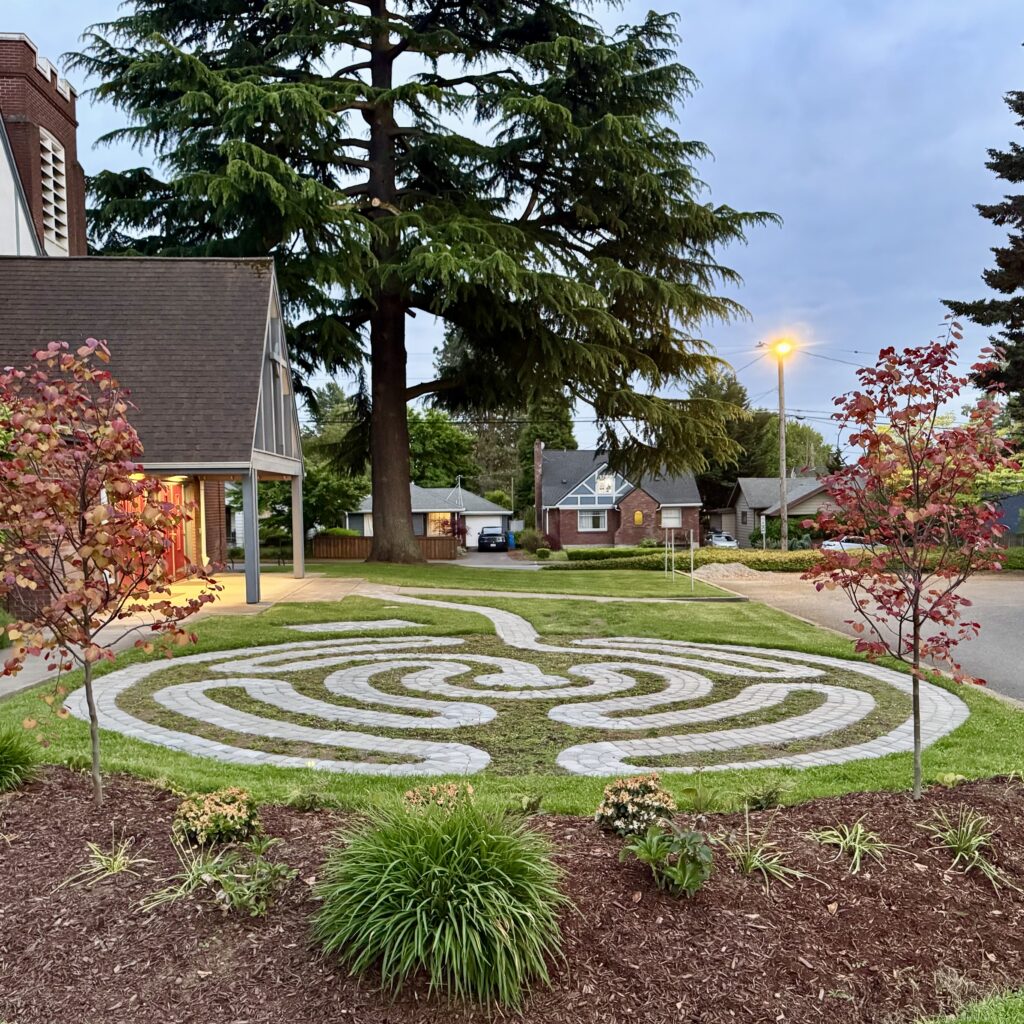
A January fundraiser jump-started the process of raising the $45,000 needed. When completed, the labyrinth will resemble the 11-circuit rosette design of the Chartres Cathedral in France “because it’s so well-known,” said the Rev. Michele Racusin, rector.
“It will be grey and a reddish color. We see it as a tool for evangelism and welcome and prayer,” she said, adding that she hopes to break ground within a few months.
Both Racusin and DeGraff said they believed the labyrinth’s presence would telegraph an invitation to community members to take their own metaphorical journeys. They hope to convey that, while “the church is a sacred space, [it also is] a place of prayer open to the entire community, to anyone who needs it,” DeGraff said.
Personalized construction
Jay and Connie Moody also used the Chartres Cathedral design when they built a labyrinth last September at St. Thomas the Apostle Center in Cody in the Diocese of Wyoming.
They added a personal touch to the construction. “We invited everyone in the diocese to bring rocks for it, so we have a good representation from across the diocese with the stones,” said Jay Moody, 62, resident manager of the 300-acre year-round retreat center.
The result was more than 1,800 stones – each roughly 10 inches wide, a foot high and three inches thick – arranged vertically to form the six-petal rose center design and surrounding circular paths. Gravel fills the areas between the lines.
“We wanted to be able to place the stones deeply enough so they wouldn’t fall over,” Moody said.
“We have a great mix here – sandstones in various colors and also volcanic rock,” said Moody, who walks the labyrinth regularly, weather permitting.
Building the labyrinth was meaningful, he said. “When you’re doing a project like this, it’s a silent time. It gave me an opportunity to connect with this place in a more spiritual way.”
After a contractor leveled the area, approximately 70 feet in diameter, the couple laid the stones.
“We felt the labyrinth would add to the depth of the experience of having a retreat here,” Moody said, “because it really represents what we try to do at the center,” located a short distance from Yellowstone National Park.
“It is really our goal when folks come here that they can leave the busy-ness of their everyday lives behind and are able to quiet their minds and to leave here with more open hearts and a bit more insightful about their own spirituality and a little bit more at peace with their relationship with the world,” he said. “We really feel the labyrinth embodies that.”
It also became an intensely personal experience for him.
“As I laid the stones, I thought about what the pathways really meant as I was building them,” he recalled. “Essentially, you walk the path and are trying to move away, to free yourself from the trials and tribulations and influences of daily life. Many times, I was literally on my hands and knees, praying and placing the rocks.”
– The Rev. Pat McCaughan and Sharon Sheridan are Episcopal News Service correspondents.
Episcopal Church Asiamerica Ministry to celebrate 40th anniversary
[Episcopal Church Office of Public Affairs] The Episcopal Church Asiamerica Ministry will celebrate its 40th anniversary June 20-24 in San Francisco CA. Focusing on the theme “EAM@40: Remember, Celebrate and Re-Envision Our Mission,” the conference will celebrate the 40 years of Asiamerica Ministry, from its beginnings when a handful of Chinese and Japanese clergy gathered in San Francisco on March 1973.
“What began as modest vision has grown into a conglomeration of diverse ethnic convocations of over a hundred self-identified churches—Chinese, Japanese, Korean, Filipino, South Asian and Southeast Asian,” explained Rev. Dr. Winfred B. Vergara, Episcopal Church Missioner for Asiamerica Ministries. “’Asiamerica’ as a word was coined by the pioneers and has evolved into three areas of ministries: ministries to Asian immigrants in America; ministries to American born Asian-Americans; and ministries of bridge-building to churches in Asia and the world.”
At the opening Eucharist two historical Asian American figures, the Rev. Hiram Hisanori Kano and the Rev. Dr. Winston Ching, will be honored along with the living pioneers. Kano, whose name is being considered for “Holy Women and Holy Men,” championed the cause of immigrant farmers in the 1930’s and became a spiritual leader in the infamous Japanese Internment Camps during World War II. Ching pioneered the EAM and sought to establish links with the Asian churches. Bishop Mary Gray-Reeves of El Camino Real will be the celebrant and Vergara will preach.
Conference speakers will include clergy and lay leaders who emphasize the memory of those who pioneered EAM. Among key conference events:
• Bishop Stacy Sauls, chief operating officer of the Episcopal Church Center will keynote on “Domestic Mission: Focus on Poverty.”
• Dr. Rodger Nishioka, professor of Columbia Theological Seminary in Atlanta, GA, and noted motivational speaker, will keynote on “Global Mission: Focus on Asiamerica”
• The June 23 Eucharist service will feature a multicultural liturgy complete with Chinese dragon dance, Philippine gongs, Korean drums and colorful Asian cultures. Preacher will be Presiding Bishop Katharine Jefferts Schori; the main celebrant is Rev. Dr. Fran Toy, first Asian American woman to be ordained in the Episcopal Church.
Complete information including registration is here
For more information, contact Vergara, wvergara@episcopalchurch.org.
Thousands greet archbishop on final day of prayer pilgrimage
[Lambeth Palace -- Press Release] Thousands of people flocked to see Archbishop Justin in Chichester today (March 19) for the final stop on his journey in prayer.
Officials from Chichester Cathedral said 3,000 people were present to see the Archbishop of Canterbury, who will be enthroned in Canterbury this Thursday.
From 11.45am he walked from the Market Cross to the Chichester Cathedral along West Street, stopping regularly to speak to people.
The Archbishop said visiting the city and its cathedral was a “real treat” as he was not too familiar with the area.
In an interview with the BBC, the Archbishop said he is praying for those “really let down” let down by the church in the Diocese of Chichester.
In February Robert Coles, a retired priest from Eastbourne, was jailed for eight years for abusing three boys between 1978 and 1984.
Archbishop Justin spent the rest of the afternoon in the cathedral, speaking with people and leading hourly daily prayer sessions.
Click here to see more pictures of Archbishop Justin’s prayer pilgrimage in Chichester.
Nothing transforms us more than prayer, says archbishop of Canterbury
[Lambeth Palace -- Press Release] The Archbishop of Canterbury said today he was “overwhelmed” by the support of Cornish people on the fourth day of his pilgrimage – and that “nothing transforms us more than prayer.”
Archbishop Justin was visiting Cornwall on the fourth day of his journey in prayer, which concludes in Chichester tomorrow (March 19).
Speaking at Lemon Quay after a performance by local school children, the Archbishop said the county faces “particular economic challenges” but he was “optimistic” for the future.
He added: “I’m quite overwhelmed. There’s a big crowd. It’s a huge privilege to be here.”
The Archbishop announced he would spend return to Cornwall for a three-day visit in November, adding that he was looking forward to learning more about the area and work of the Church there.
Archbishop Justin will be enthroned at Canterbury Cathedral on Thursday 21st March.
‘Change the world in one hour,’ says Southern Africa archbishop
[Anglican Communion News Service] Archbishop Thabo Makgoba of the Anglican Church of Southern Africa has urged Anglicans in Africa and around the world to support Earth Hour by “switching off your lights” and “switching on to saving the world.”
Earth Hour, observed this year on March 23, is an annual worldwide event organized by the World Wide Fund for Nature (WWF). It encourages households and businesses to turn off non-essential lights for one hour to raise awareness of the need for action on climate change.
“In one hour you can change the world,” said Makgoba, who also chairs the Anglican Communion Environmental Network. “Let this be the first hour of a new life of energy saving, and living lightly.”
The archbishop acknowledged the importance of preserving the world for posterity. “We have no other option to preserving our world for future generations,” he said. “There is no planet B [and] we have no alternative!”
The event first took place in 2007 when 2.2 million residents of Sydney, Australia, turned off their non-essential lights, and in 2008 many other cities round the world did the same.
This Saturday (March 23), everyone on the planet is urged to switch off their lights from 8:30 – 9:30 p.m. to show their commitment to a sustainable future. They are then to make that commitment tangible in long-term choices for more environmentally friendly living.
Botswana Anglicans are hospice service trailblazers
[Anglican Communion News Service] Walking into the Holy Cross Hospice in Gaborone, Botswana, one may be greeted with charming smiles and the sweet aroma of food emanating from the kitchen. The environment is so full of life and welcoming. This is not exactly what most people would expect.
For many people, a hospice, being a place for the terminally ill, would be a sombre and lifeless place. But not at Holy Cross.
“When I came to this place, I was not able to walk but now I can,” revealed David Brasso Matlhoki with a smile. He is one of the terminally ill patients at the hospice. “This hospice gave me the care, support and treatment I needed. I would like to see it grow since it’s very important to us.”
He added: “I encourage other churches in Africa to come to Botswana and see how this place operates so that they can go back and open hospices.” Matlhoki is just one of the more than 20 clients currently benefiting from medical, nursing, spiritual and nutritional care provided by the hospice.
The other patients were waiting for their lunch in the courtyard while playing board games. The volunteer staff also were busy performing various tasks meant to help the patients “live their last days with dignity by making the best of each day.” Smiles, courage and hard work are evident even in the face of one of life’s most daunting psychological challenges.
“I almost committed suicide before coming to the hospice because I didn’t know I was going to make it,” revealed another patient, Boitumelo Mabolola. “Before coming to the hospice, I was always home alone because I was bedridden and had no one to take care of me. Coming to the hospice made me meet other people that are going through similar circumstances and it helped me grow spiritually and accept my status,” she said.
HIV/AIDS still remains a major challenge for Africa and the world as a whole and ranks highly among terminal illnesses suffered by people on the continent. Botswana is no exception, having one of the highest HIV prevalence rates in Africa.
According to reports, it is the second highest in the world, topped only by Swaziland. Though the government has put in place various mechanisms such as massive sensitization programs and the provision of anti-retrovirals (ARVs) and other services to address the spread of the virus, the general scenario is still worrying.
For this reason the Anglican Communion makes health issues a top priority, and through the Anglican Health Network the church is a major and strategic partner in working towards the Millennium Development Goals (MDGs) and delivering health improvements to the poor. In the face of such challenges, Anglicans in Botswana did not turn a blind eye to the HIV situation in their country. They responded by drawing from the Gospel call to “go out and heal the sick.”
In 1994, members of the Holy Cross Cathedral of the Anglican Diocese of Botswana, in conjunction with the Rotary Club, founded the Holy Cross Hospice using volunteers and the strengths of a common Anglican identity in mobilizing resources and expertise. The hospice is a registered welfare and non-governmental organization based in the capital Gaborone and established specifically to “respond to the palliative care services” for persons living with terminal illnesses.
Running a hospice is a unique calling and hospices are important to the dignity of any society. Erik Isaksson, acting manager for the hospice, agreed.
“Meeting a person who is in the final stages of their life often gives access to the very important, personal and urgent needs of a person and this, to me, is like being given a very special gift,” he said. “We are now putting more emphasis on end-of-life and focusing on people with life threatening and progressive illness. We direct our services to all, regardless of race or religious affiliation.”
Despite the ability of the hospice to provide holistic care and also to address the physical, spiritual, social and psychological needs of the patients at no cost at all, it faces a major financial challenges. All the clients are from impoverished backgrounds and could never afford to pay even if they were asked to do so.
It goes without saying, therefore, that financial support would increase the hospice’s capacity to handle clients and help them spread their reach beyond Gaborone, which is currently the only city from which they accept clients.
Pearl Ncube is the volunteer resource mobilizer for the hospice and has been working hard to source funding. She is proud about the success of the hospice over the years and explains the work model that has helped the hospice thrive.
“This hospice totally relies on donor funds. We have always chosen to deal with volunteer workers because we cannot afford to have fully employed and paid experts due to financial challenges. We also like to work with interns from colleges and universities,” she said.
The Holy Cross Hospice may be facing challenges but this has not lessened its resolve to help people, many of whom are living the last days of their life. It has received awards for its exceptional service and commitment to supporting the people of Botswana.
“We are the first hospice to operate in Botswana,” explained Ncube. “We have been a leader in the provision of palliative care throughout the years and have been able to rehabilitate our clients, most of whom have been able to go back to their families and live normal lives.”
Though small, the hospice has a gym, a massage room and a lounge area. Clients are encouraged to eat healthy foods and also take time to mingle with others. They are also taught various skills such as basketry and other artistic skills to help them settle down well and also for them to have a source of income.
Immaculate Tambala is a volunteer social worker at the hospice. “Since most of [the clients] are HIV positive, we teach them a lot about what the disease is all about and how it should be managed,” she said. “We also counsel the clients and find out what they really need. We do a comprehensive assessment of the support system that they have in their homes to make sure they are well embraced and supported in their own homes and communities.”
The hospice has also tried to tackle some of its challenges by cooperating with other hospices in Botswana as manager Isaksson explained. “We are cooperating with another hospice in Metsimothlabe run by the [Roman] Catholic Church. They are a state-of-the-art inpatient hospice and help us with patients who need 24-hour care,” he said. “We are also in close dialogue with the oncology department at the local hospital, Princess Marina, for referrals. We can proudly say that we have been an active part of the formation of the Botswana Hospice and Palliative Care Association.”
Social worker Tambala added: “Working with the terminally ill can be stressing and tiring. Some situations are so sad but I get to learn a lot from the clients. It gives me an opportunity to try and understand what the clients are going through. I wish other people would also see the value of this.”
‘Injustices’ toward Japanese Canadian Anglicans acknowledged
From left to right: Lynne Shozawa and Joy Kogawa present Archbishop Fred Hiltz with a memorial plaque that tells the story about the fate of Japanese Canadian Anglican churches before and after World War II. Photo: Marites N. Sison/Anglican Journal
[Anglican Journal, Mississauga, Ontario] The Council of General Synod (CoGS) on March 14 acknowledged the injustices and racism experienced by Japanese Canadian Anglicans at the hands of the Anglican Church of Canada during and after World War II, and said it confessed “the error of our ways.”
CoGS, the church’s governing body between General Synods, also supported the 2010 apology made by Bishop Michael Ingham for the sale of Japanese congregation churches in the Diocese of New Westminster during World War II and months after Japanese Canadian exiles returned to Vancouver.
In a resolution, CoGS said it recognized that “deep-seated historic racism continues as a source of pain to Japanese Canadians across Canada” and commended “every effort in the interests of healing and reconciliation.”
Archbishop Fred Hiltz supported the resolution, calling it “a sign to the whole church to acknowledge sins of the past…[one that] expresses a desire to be continually reconciled.”
The resolution was approved after an emotional presentation made by members of the Japanese-Canadian Vancouver Consultation Council (JC-VCC) who had spent more than a decade digging into the truth about what happened to their churches during the war.
In 1942, the Canadian government ordered Japanese Canadians — 22,000 of them from British Columbia — to pack a single suitcase, then sent them to internment camps. The push to confine them to shantytowns in the wilderness came from Ian MacKenzie, federal cabinet minister from B.C., and provincial politicians angered by the December 1941 Japanese attack on Pearl Harbor and fearful of an invasion of the Pacific coast.
“It is my personal intention, as long as I remain in public life, to see they never come back here,” MacKenzie had pledged. “Let our slogan be for British Columbia: ‘No Japs from the Rockies to the seas.’ ” In 1943, the federal government ordered the sale of all properties seized from Japanese Canadians.
Such virulence extended to the church, the JC-VCC’s investigation showed. And that, said Greg Tatchell in his presentation to CoGS, “has been the hardest part of our project.”
Their research showed that New Westminster held three pre-World War II Anglican church properties in trust for 1,500 Japanese Canadian parishioners in Vancouver, said Tatchell. Two, including Church of the Ascension, were sold in 1945 near the end of World War II; one, Holy Cross Church, was sold after the war, on Aug. 19, 1949, several months after the first Japanese Canadians were allowed to return to Vancouver.
“The sale of the church after the war ended was especially insensitive and wrong,” said Lynne Shozawa, her voice breaking. Shozawa was born to Japanese Anglican parents in an internment camp in B.C.
The diocese had also held the funds of these congregations, but after their exile ended and they were allowed to return to Vancouver, the diocese opted to divert $8,107.64 of these funds into the Bishop’s Endowment Fund, with authorization from the diocesan executive council.
Instead of welcoming back their Japanese Canadian parishioners after the war, the diocesan executive council passed a motion on May 10, 1949, stating that “the need for Japanese Mission work was nil.”
In 1953, the Rev. Canon Tim Makoto Nakayama — then studying to become a priest — asked then bishop of the diocese of New Westminster, Godfrey Philip Gower, what had happened to the Japanese Canadian churches and was simply told, “They were relinquished.” Nakayama, whose father was the priest at the Church of the Ascension before the war, was “stunned,” said Tatchell.
Tatchell said their research showed that “institutional racism” was aided by the fact that the diocese’s executive council had included one of the “worst purveyors” of racism, Halford D. Wilson, an alderman who made no secret that he despised Japanese Canadians.
The JV-VCC delegation, which also included well-known Japanese Canadian author Joy Kogawa, said they came to CoGS “to seek your support in finding some kind of reconciliation.”
CoGS’s approval of the resolution, submitted by the partners in mission and eco-justice committee, is an assurance that “a justice has been revealed and acknowledged,” said Shozawa. “This marks just the beginning for us. We are heartened by the church’s promise to be with us on the road to healing and reconnection with those we lost.”
She added that while there were church leaders who turned their backs on Japanese Canadian Anglicans during the war, there were others who stood by them. “We remember with love the missionary workers and clergy who followed us to the camps. They were the face of the church,” she said. “We are grateful to these few who were so faithful in their calling that they inspired within us a similar commitment to this day.”
They presented the primate, Archbishop Fred Hiltz, with a bronze Relinquished Memorial Plaque, which includes highlights from their research and Ingham’s apology; the same plaque has been mounted next to the pulpit of Holy Cross Japanese Canadian Anglican Church, and the primate has promised to hang it at the national church office in Toronto.
“This is our story, our small memorial, to remind us to see what we do not see and to care for the least among us, whoever they may be,” said Shozawa in her presentation of the plaque.
—With files from Topic, CBC Archives and B.C. Archives
Pope Francis brings humility to installation
[Episcopal News Service] It was a beautiful day in Rome. A million people, from heads of states to beggars, basked in the sunlight, as military and television helicopters flew in circles above us.
A hundred national flags flapped above the great crowd, along with big banners in Polish and Spanish. The Anglican delegation, headed by Archbishop of York John Sentamu, was seated close to the huge altar, behind the Catholikos of the Armenian Church, Karekin I, and next to the Orthodox delegation. They were sitting behind the Ecumenical Patriarch, Bartholomew I, the head of 350 million Orthodox believers. No one had calculated the last time a patriarch attended the inauguration of a papacy, but it must be at least one thousand years.
That was the first of several extraordinary gestures. Pope Francis showed up early in the Popemobile, which was without bulletproof glass. Applause and shouts followed his progress around St. Peter’s Square. Then he cut off the opening anthem, “Tu es Petrus” — an anthem of papal power — not because he seemed in a hurry but to make a point. First, he’s the pope, and he can do what he wants. Second, given the tenor of the rest of the Mass, Francis wanted to start on a more humble note.
His vestments and miter were simple, the hundred or so cardinals’ magnificent chasubles and miters outshining the pontiff’s. In the homily he referred to himself as “The Bishop of Rome” — the title given in the Thirty-Nine Articles to the popes. Despite having only one lung, his sermon was full-voiced, punctuated by a few blows to the lectern. The Methodists sitting with us said he could be a Methodist! Many of the delegations were visibly moved.
This contrasted with the softness of his tone as he celebrated the Mass. Francis sounded genuinely choked up at times.
Going back to my hotel, I asked the taxi driver what he thought of the new pope. In his Roman accent, he said, “he is a man of the people, simple and humble.” He likes what he sees so far.
One Roman Catholic priest, shepherding some of the delegates, looked out at the Popemobile and Pope Francis reaching out, touching people, and said, “We don’t know what to expect anymore.” The Anglicans agreed among ourselves that that is a good thing.
– Bishop Pierre Whalon of the Convocation of Episcopal Churches in Europe was part of the official Anglican Communion delegation attending the pope’s installation on March 19.
Holy Week, Easter worship available on Episcopal Church website
[Episcopal Church Office of Public Affairs -- Press Release] The Office of Communication will present worship offerings every day of Holy Week. The offerings will be available on a special page of the Episcopal Church website here.
Palm Sunday, March 24 – New Orleans Second Line Procession with Jazz Band from St. Paul & St. James Church, New Haven, CT (Diocese of Connecticut) (this will be posted on Monday).
Monday, March 25 - Audio service of solemn Eucharist including music from Saint Thomas, Fifth Avenue, NYC (Diocese of New York) 12:10 pm Eastern
Tuesday, March 26 - Audio service of solemn Eucharist including music from Saint Thomas, Fifth Avenue, 12:10 pm Eastern
Wednesday, March 27 - Tenebrae audio of service from Saint Thomas, Fifth Avenue, 5:30 pm Eastern
Maundy Thursday March 28 – Traditional Holy Thursday service with readings and foot washing Calvary and St. George’s, NYC (Diocese of New York) at 7 pm Eastern
Good Friday, March 29 – Service from Calvary-St. George’s, noon Eastern
Holy Saturday, March 30 - The Great Easter Vigil with traditional readings and music from Calvary-St. George, 8 pm Eastern
Easter Sunday March 31 – Easter Service in partnership with the Cathedral of St Mark Cathedral, Salt Lake City, UT (Diocese of Utah)
Sewanee programs center welcomes new leadership
[Sewanee, School of Theology -- Press Release] The Rt. Rev. J. Neil Alexander, dean of The School of Theology, has appointed Dr. Courtney Cowart as associate dean and director of the School’s programs center. James Goodmann has been appointed the center’s associate director. These appointments were effective March 1, 2013.
Building on the success of the programs center’s international Education for Ministry (EfM) program, Cowart will lead an expansion that envisions a new role for the center as the nexus of collaborative learning and creativity for an increasingly diverse body of participants from all parts of the Church.
Alexander explains, “While we celebrate the many achievements of the programs center and EfM in the past, we believe there is great potential for the programs center to reach more people, and, importantly, to reach groups the church as a whole has been less successful in reaching. As America grows more diverse (and as it grows younger) a revitalization of the programs center will help The School of Theology, The Episcopal Church, and the broader Christian church in America.”
Cowart and Goodmann are co-creators of VocationCARE, a vocational discernment and ministry design process, initiated through support of The Fund for Theological Education. They will work closely with EfM Director Karen Meridith and the EfM staff to integrate VocationCARE and other new programs into the center’s operations. “In the spirit of our collaborative work with the Kaleidoscope Institute and the Missioner for Hispanic/Latino ministries, EfM looks forward to exploring new opportunities for partnerships that will come with this new venture,” says Meridith.
Goodmann shares, “The experience of both VocationCARE and EfM anticipates the work of a renewed programs center. Both of these ways of practice serve those moving into deeper forms of discipleship. Mutual engagement of both VocationCARE and EfM promises to attract other programs with a similar inspiration and this, we believe, will amplify gifted voices needed by the larger church.”
Several new initiatives are in development for the expanding programs center, as the center’s staff casts a wide net to engage developers of other promising programs as potential future offerings of the center. Two initiatives are already underway.
“With a recent grant from the Henry Luce Foundation, EfM is embarking on the development of a Latino/Hispanic version of the EfM curriculum,” states Cowart. “Additionally, the new Episcopal Service Corps–Sewanee (ESC) will begin in August of 2013, under the direction of Michael Trent Thompson. This is the latest addition to an expanding network of 30 ESC programs flourishing in many locations throughout the church.”
Cowart is a scholar in the fields of ascetical theology and American Church history (Th.D., The General Theological Seminary, 2001) that has identified, supported, and developed outstanding programs of the church for 15 years. Her new position draws on her background as a theological educator and her programmatic experience with Trinity Grants in New York, as co-director of the Office of Disaster Response in New Orleans post-Katrina, and as director of congregational learning for The Fund for Theological Education. Cowart’s book, An American Awakening: From 9/11 to Katrina the People We Are Free To Be, published in 2008, chronicles her work following September 11 and Hurricane Katrina.
Goodmann earned a B.A. from the University of Toronto (St Michael’s College) and his M.Div. from Yale University Divinity School. He has 20 years of experience in working with young people in vocational discernment and with institutions that support that discernment (campus ministries, universities, nonprofit grants work). Goodmann has served as director of congregational grants at the Fund for Theological Education in Atlanta, Ga. Prior to that, he served as program director for the Lilly Endowment-funded Theological Exploration of Vocation at Sewanee, with a focus on working with undergraduates in vocational discernment.
The School of Theology, an accredited Episcopal seminary, offers study within three divisions: degree programs, extension programs, and continuing education programs. Sewanee is one of two Episcopal seminaries that is embedded in a larger university having a college and other graduate programs. The School of Theology has continued to define its role as a premier residential seminary in The Episcopal Church with an expanded programs center as a resource to the Church.
Presiding bishop’s Easter message 2013
[Episcopal Church Office of Public Affairs] “Easter celebrates the victory of light and life over darkness and death,” Episcopal Church Presiding Bishop Katharine Jefferts Schori rejoices in her Easter Message 2013.
The following is the Presiding Bishop’s Easter Message.
Easter Message 2013
Rejoice, rejoice and sing, rejoice and be glad… for earth and heaven are joined and humanity is reconciled to God! [1]
As the Lenten season ends in Easter rejoicing, note what has been wrought in you this year. A remarkable cross-section of America has been practicing Lenten disciplines, even some who are not active Christians. [2] There is a deep hunger in our collective psyche to re-orient our lives toward life and light, healing and peace. We share a holy hunger for clarity about what is good and life-giving, and we yearn to re-focus on what is most central and important in life.
Easter celebrates the victory of light and life over darkness and death. God re-creates and redeems all life from dead, dry, and destroyed bones. We are released from the bonds of self-obsession, addiction, and whatever would steal away the radical freedom of God-with-us. Our lives re-center in what is most holy and creative, the new thing God is continually doing in our midst. Practicing vulnerability toward the need and hunger of others around us, we have cultivated compassionate hearts. We join in baptismal rebirth in the midst of Jesus’ own passing-over.
The wonder of the resurrection is upon us once more. May we embrace God’s ever-new life with every cell of our being, every yearning of our soul, and every muscle of our will. Christ is risen, death is vanquished, humanity is restored to holy and creative relationship with God’s ongoing and eternal liveliness. Praise God who brings light out of darkness, life out of death, and newness out of the stale and moribund. Alleluia! Christ is risen!
The Most Rev. Katharine Jefferts Schori
Presiding Bishop and Primate
The Episcopal Church
[1] From the Exsultet, Book of Common Prayer pp 286-7
[2] http://www.nytimes.com/2013/03/16/us/a-ritual-of-lent-attracts-nonbelievers.html?_r=0
Mensaje de la Obispa Presidente de la Iglesia Episcopal para la Pascua de 2013
[19 de marzo de 2013] “La Pascua celebra la victoria de luz y vida sobre las tinieblas y la muerte”, la obispa presidente Katharine Jefferts Schori se regocija en su mensaje de la Pascua de 2013.
A continuación se encuentra el mensaje para la Pascua de la Obispa Presidente.
Mensaje para la Pascua de 2013
¡Regocíjense, regocíjense, y canten, regocíjense y alégrense… porque la tierra y el cielo están unidos y la humanidad se reconcilia con Dios! [1]
A medida que la temporada de la cuaresma finaliza con la alegría de la Pascua, tenga en cuenta lo que se forjado en usted este año. Una notable muestra representativa de América ha estado practicando las disciplinas cuaresmales, aun aquellos que no son cristianos activos.[2] Hay un hambre profunda en nuestro espíritu colectivo para reorientar nuestra vida hacia la vida y la luz, la sanación y la paz. Nosotros compartimos un hambre santo para mayor claridad sobre lo que es lo bueno y vivificante, y nosotros anhelamos volver a concentrarnos en lo que es más primordial e importante en la vida.
La Pascua celebra la victoria de la luz y la vida sobre las tinieblas y la muerte. Dios recrea y redime toda vida de huesos muertos, secos y destruidos. Nosotros somos liberados de las ataduras de auto-obsesión, adicción y de lo que pueda robar la libertad radical de Dios con nosotros. Nuestras vidas se vuelven a centrar en lo que es más sagrado y creativo, y en lo que Dios continuamente está haciendo en medio de nosotros. Al practicar la vulnerabilidad hacia la necesidad y el hambre de los que nos rodean, hemos cultivado corazones compasivos. Nos unimos en el renacimiento bautismal en medio de la propia celebración pascual de Jesús.
La maravilla de la resurrección está sobre nosotros una vez más. Acojamos siempre la nueva vida en Dios con cada célula de nuestro ser, con cada anhelo de nuestra alma, y con la fuerza de nuestra voluntad. Cristo ha resucitado, la muerte es vencida, se restaura la humanidad en relación santa y creativa con la vivacidad permanente y continua del eterno Dios. Alabado sea Dios que trae luz de las tinieblas, vida de la muerte y la renovación de lo obsoleto y moribundo. ¡Aleluya! ¡Cristo ha resucitado!
La Rvdma. Katharine Jefferts Schori
Obispa Presidente y Primada
La Iglesia Episcopal