

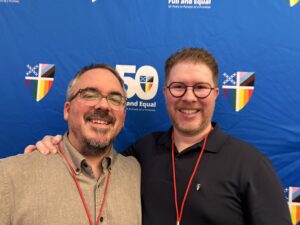
 Two members of the Diocese of Olympia, Colton Carothers and Michael Seewer, recently attended a conference offered by The Episcopal Church called “Full and Equal: 50 Years in Pursuit of a Promise” September 3-5 in Minneapolis. The conference was both a celebration and a call to action 50 years after the passing of resolution A069 at the 65th General Convention, which affirmed that “homosexual people are children of God with a full and equal claim upon the church’s love, acceptance, and pastoral concern and care.”
People from across The Episcopal Church attended the 3-day conference, which was hosted at the site of the 65th General Convention in Minneapolis. Included in the conference were a variety of workshops and networking opportunities. Speakers included: The Rev. Canon Susan Russell, president of Integrity USA (2003-2009) and member of the leadership team of The Episcopal Church’s LGBTQ Caucus; The Most Rev. Sean Rowe, Presiding Bishop of The Episcopal Church; and The Rt. Rev. Gene Robinson, IX Bishop of New Hampshire and first openly gay bishop in the Anglican Communion.
The overarching theme of the conference was storytelling, with the plenaries and workshops offering opportunities to share stories from our church’s history toward broader inclusion, and further opportunities to meditate and pray on what work we are being called to as we pursue the promise of further inclusion and welcome of all.
Both Colton and Michael left the conference, inspired to live into the call of how we can continue to share the sacred stories of the queer experience in our church and diocese, as well as how we might engage each other as we continue striving for further inclusion. Stay tuned for more information on how you can be a part of future conversations.
The 3-day conference culminated with a closing worship opportunity at St. Mark’s Cathedral in Minneapolis, during which The Rt. Rev. Gene Robinson offered a heartfelt sermon reflecting on Matthew 14:22-33 (Peter walking on water), the difficult journey of being the first openly gay bishop in the Anglican Communion, and the difference between a dream and a miracle. The dream of queer equality in The Episcopal Church being realized was a journey, and it took hard work to get where we are today. Bishop Robinson honored the blessed memory of those who have gone before us, whose hard work helped to realize the dream of a better tomorrow for our LGBTQ+ siblings, and on whose shoulders we stand. Like Peter, who dreamed of walking on water, and whom Jesus scooped up when he faltered, we are called to dream, and to journey toward making that dream a reality.
You can watch the full liturgy on the St. Mark’s Cathedral (Minneapolis) Facebook page here.